The Panic of the First Fall Heating Cycle
That sudden, alarming smell of burning dust filling your living room is one of the most common homeowner questions answered during the first October cold snap in Missouri. You turn on the thermostat, the blower motor spins to life, and within minutes, an acrid odor pours out of your vents. Your immediate reaction is to wonder if something is on fire inside the walls. This is a critical decision point for your home's safety: do you just let the system run and hope the smell fades, or do you shut it down immediately at the breaker and call a professional?
Maintaining the health of your entire system—from the furnace itself to comprehensive sheet metal services and custom ductwork fabrication—is the key to a safe, odor-free winter.
The anxiety you feel during that initial heating cycle is completely valid. After sitting dormant for months, your heating equipment undergoes a sudden, intense thermal shift. Understanding exactly what is happening inside your utility closet and your ductwork is the first step in diagnosing the overall health of your system. When you know what is burning, where the smell originates, and how your ventilation network contributes to the problem, you can confidently decide whether your system needs a simple filter change or an urgent professional inspection.
Why Does My Heater Smell Like Burning Dust?
To understand why that distinct odor takes over your house during the first October cold snap in Missouri, you have to look at what happens while your furnace is turned off. Throughout the spring and summer, your heating components sit idle. During this dormant period, normal household debris—including pet dander, dead skin cells, airborne cooking oils, and standard household dust—gradually settles on the internal components of your furnace, particularly the heat exchanger.
The Role of Summer Humidity in Debris Buildup
Missouri's notoriously hot, humid summers play a massive role in this seasonal phenomenon. When the air inside your home is thick with moisture, the dust floating through your ductwork becomes heavy and sticky. Instead of simply blowing through the vents, this damp dust clings to the metal walls of your ducts and coats the inactive heat exchanger.
• Sticky accumulation: Moisture in the air acts like a mild adhesive, causing normal airborne particles to form a stubborn layer of grime.
• Dormant airflow: Because the heating cycle isn't running, there is no high-temperature air to clear this debris out, allowing it to accumulate heavily for months.
• The curing effect: As the summer transitions into a drier fall, that sticky layer of dust dries out and hardens directly onto the heating elements.
The Incineration Process
When you finally switch your thermostat to "heat," the internal temperatures inside the furnace heat exchanger rapidly rise to several hundred degrees. The hardened, settled debris that accumulated all summer is suddenly subjected to intense heat. What you are smelling is the literal combustion of this harmless household dust.
This incineration process produces a very distinct, temporary odor. It is a standard physical reaction to the first ignition of the season, not necessarily a mechanical failure. Reassuringly, understanding that this smell is simply summer dust burning off is the first step in diagnosing your system's health. However, knowing the difference between burning dust and burning electrical components is critical.
Normal Burn-Off vs. When to Shut Down the System
A typical pattern we see in De Soto and Jefferson County is homeowners waiting too long to shut down a failing system, or conversely, panicking over a perfectly normal startup cycle. Establishing clear, actionable criteria helps you make the right call when that initial odor hits your nose.
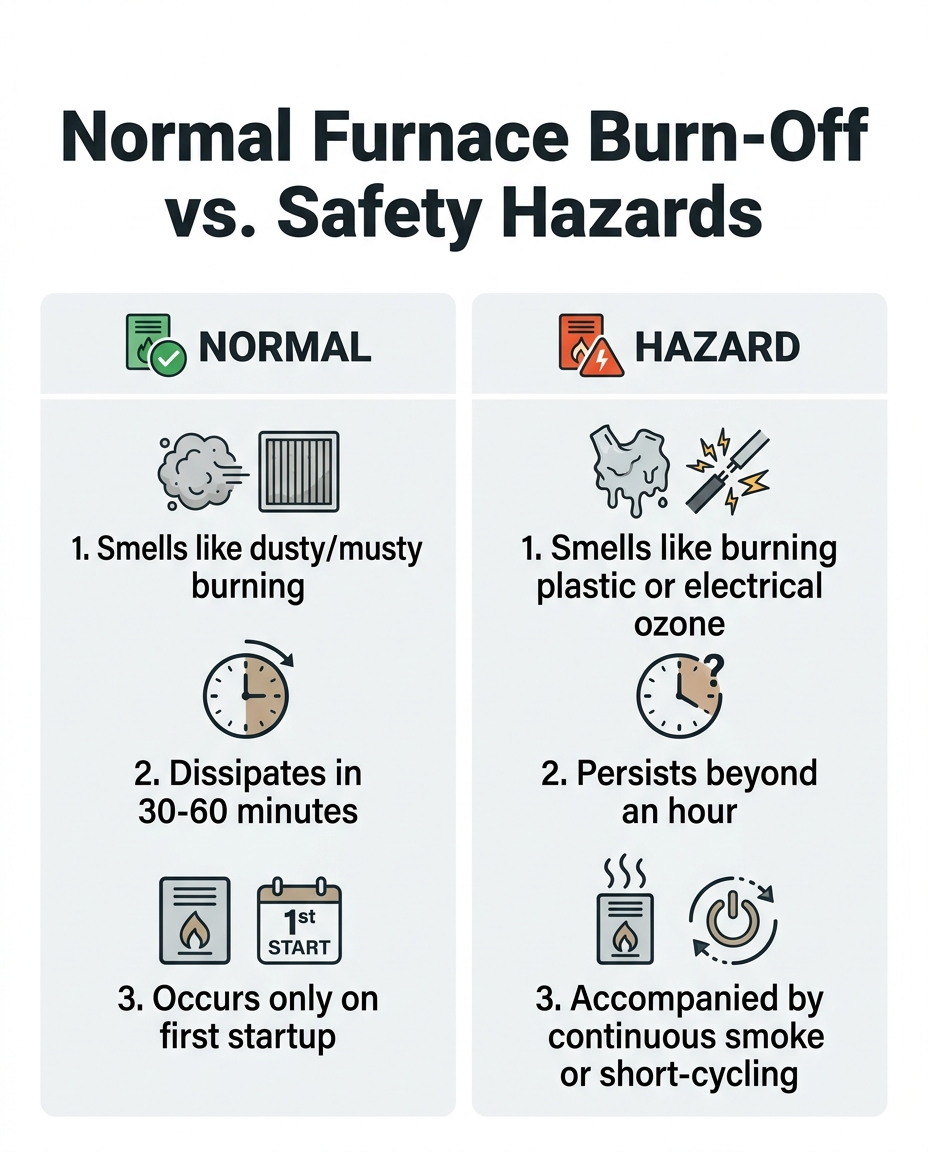
The 30-to-60 Minute Rule: Normal dust burn-off smells should dissipate within an hour of the first heating cycle. If the smell is fading and your house is successfully warming up, the system is likely just clearing its throat for the winter. However, if the smell changes character or persists, you need to take action.
• Musty, dusty burning smell lasting 30-45 minutes — Likely Cause: Normal incineration of settled summer dust on the heat exchanger. — Required Action: Monitor the system. Ensure the smell fades within an hour.
• Acrid smell of melting plastic or rubber — Likely Cause: Failing capacitor, melting wire insulation, or a foreign object in the blower. — Required Action: Shut down immediately. Turn off the system at the thermostat and breaker.
• Sharp, metallic "electrical ozone" odor — Likely Cause: Overheating blower motor or severe electrical short circuit. — Required Action: Shut down immediately. Call a licensed professional for an emergency inspection.
• Continuous smoke from vents or short-cycling — Likely Cause: Cracked heat exchanger or severely restricted airflow causing overheating. — Required Action: Shut down immediately. Do not run the system until it is professionally evaluated.
Short-cycling is a particularly dangerous warning sign. This occurs when the furnace turns on, runs for a few minutes, and shuts off prematurely before reaching the target temperature. This usually indicates that the system is overheating due to severe airflow restriction, forcing the internal safety switches to trigger. If you experience electrical smells, melting plastic odors, or short-cycling, turn off the thermostat immediately and cut the power at the breaker to prevent further damage or fire risks.

The Hidden Culprit: How Leaky Ductwork Traps Summer Debris
While the heat exchanger is the site of the incineration, a significant portion of the debris causing that terrible smell originates from within the duct system itself. Homeowners often blame the furnace unit, but the structural integrity of your aging ductwork is usually the hidden culprit behind persistent odors and poor indoor air quality.
Many older homes in De Soto and Jefferson County rely on original ductwork that has degraded over decades. Poorly sealed joints, sagging flexible lines, and rusted metal allow unconditioned air to infiltrate the system. When ducts leak, they act like a vacuum, pulling fiberglass insulation particles, attic dust, and crawlspace debris directly into your breathing air. This massive influx of contaminants settles into the system all summer, creating a much larger volume of debris to burn off in the fall.
The Efficiency Toll of Air Loss
Beyond the smell, leaky ductwork destroys your system's performance. According to EPA and ENERGY STAR guidelines, leaky or poorly fabricated ductwork can reduce your system's efficiency by up to 20 percent. This air loss forces your entire setup to work significantly harder during the heating season.
• Longer run times: Lost heated air means the furnace has to run longer to satisfy the thermostat, wasting energy.
• Increased mechanical strain: The blower motor and heat exchanger endure extra wear and tear, shortening the lifespan of your equipment.
• Uneven heating: Rooms furthest from the blower receive a fraction of the necessary airflow, leaving them cold and uncomfortable.
Upgrading your duct network is just as vital as upgrading your main HVAC systems. Without an airtight delivery method, even the most advanced furnace will struggle to keep your home comfortable, and the seasonal dust buildup will only get worse year after year.
Why Sheet Metal Duct Fabrication Solves Persistent Airflow Issues
The permanent solution to leaky, inefficient ductwork that causes persistent smells and poor heating is custom fabrication. Off-the-shelf, one-size-fits-all ducting—especially flexible plastic or fiberglass tubing—is highly prone to sagging, tearing, and degrading over time. These imperfections create the exact gaps and valleys where dust accumulates and conditioned air escapes.
Working with an expert team means accessing superior materials. SMCI offers in-house custom sheet metal fabrication, ensuring precise fits for local homes, eliminating middleman delays, and guaranteeing high-quality materials that outlast generic alternatives.
The Advantage of Bespoke Fabrication
Custom-measured and fabricated sheet metal ducts are engineered specifically for the unique layout of your home. This bespoke approach fundamentally changes how air moves through your property in De Soto and Jefferson County.
• Exact measurements: Fabricators measure the specific static pressure needs and architectural layout of your home, ensuring the ducts are perfectly sized for optimal airflow.
• Fewer joints and seams: Custom lengths mean fewer connections. Fewer connections mean fewer opportunities for air to leak out or dust to infiltrate in.
• Unmatched durability: High-quality sheet metal does not sag, tear, or collapse like flexible ducting. It provides a smooth, rigid interior surface that prevents dust from catching and accumulating.
• Improved air quality: An airtight, rigid system prevents future seasonal dust buildup, significantly improving your overall indoor air quality and reducing the severity of future fall burn-off smells.
Investing in fabricated sheet metal is an investment in the deep infrastructure of your home. It ensures that every ounce of warm air your furnace produces actually makes it into your living spaces.
Upgrading Your System: Residential and Commercial Solutions
Ductwork degradation is not just a residential problem; it affects larger commercial properties in very similar ways. Whether you are managing a cozy single-family home or a sprawling retail space in De Soto and Jefferson County, the principles of airtight, custom-fitted sheet metal apply universally.
Commercial systems, however, require scaled-up fabrication to handle significantly higher airflow volumes, heavier structural demands, and stricter municipal compliance codes. A failing commercial duct system can lead to massive energy waste, uncomfortable working conditions for employees, and poor air quality for customers. Just like a residential system, a commercial setup suffering from leaks will pull in unfiltered air from drop ceilings and mechanical rooms, leading to overwhelming odors and rapid filter clogging.
The solution remains the same: precision engineering. Upgrading to commercial custom ductwork ensures that the ventilation network can handle the immense static pressure of industrial blowers without leaking. Local experts can assess the specific airflow requirements of any building size, fabricating rigid, durable sheet metal solutions that eliminate weak points and restore total system efficiency.
Pre-Winter Steps to Ensure Safe and Efficient Heating
Before the deep freeze of winter sets in, taking proactive steps can save you from a mid-January breakdown. Preparing your system during the first October cold snap in Missouri ensures that you catch minor issues before they escalate into major safety hazards. While internal mechanical repairs must always be left to licensed professionals, there are several safe, crucial steps you can take to protect your home.
1. Replace your HVAC air filters immediately: Start the heating season with a fresh, high-quality pleated filter. A dirty filter from the summer cooling season will severely restrict airflow, causing the furnace to overheat and short-cycle during its very first run.
2. Unblock all vents and registers: Walk through every room in your house and ensure that return and supply vents are not blocked by heavy furniture, area rugs, or winter storage boxes. Blocked vents disrupt the pressure balance in your ductwork.
3. Clear the area around the furnace: Ensure there is a clear perimeter around your indoor heating unit. Remove any stored boxes, cleaning supplies, or flammable materials from the utility closet to prevent fire risks.
4. Schedule a professional pre-winter inspection: Have a licensed technician evaluate the system. They will check the electrical connections, test the gas lines for microscopic leaks, inspect the heat exchanger for hairline cracks, and evaluate the integrity of your ductwork.
5. Evaluate long-term upgrades: If your current setup is aging, failing, or constantly needing repairs, it may be time to look at highly efficient alternatives. Many homeowners are exploring modern options like geothermal heating and cooling to eliminate the risks of combustion heating entirely.
Common Homeowner Questions Answered: Frequently Asked Questions About Furnace Startups and Ductwork
When the temperature drops in De Soto and Jefferson County, anxiety over heating systems rises. We hear the same concerns every year. Here are clear, direct answers to help you navigate the start of the heating season.
Why does my heater smell like burning when I turn it on?
The smell is caused by the incineration of household dust and debris that settled on the heat exchanger during the summer. When the furnace ignites for the first time, it burns off this layer of accumulation. It is a normal physical reaction to the sudden increase in temperature.
How long should a furnace smell when first turned on?
A normal dust burn-off smell should completely dissipate within 30 to 60 minutes of the first heating cycle. If the smell lingers for several hours, or if it returns on subsequent days, it indicates a deeper issue that requires professional attention.
Is it normal for a furnace to smell like burning dust?
Yes, a temporary burning dust or musty odor is entirely normal during the first startup of the fall season. As long as the smell fades quickly and is not accompanied by smoke or strange noises, your system is functioning as expected.
When should I worry about furnace smells?
You should be immediately concerned if the smell resembles melting plastic, burning rubber, or electrical ozone, as these indicate failing components. Additionally, if the smell is paired with visible smoke or the system rapidly turning on and off (short-cycling), shut the power off immediately and call a professional.
How does aging ductwork affect furnace startup?
Aging, leaky ductwork pulls excess dust and debris from unconditioned spaces like attics and crawlspaces into the system during the summer. This creates a much heavier layer of grime on the heating components, resulting in a stronger, longer-lasting burning smell when the furnace first starts.
Can custom sheet metal ductwork improve my home's heating efficiency?
Absolutely. Custom-fabricated sheet metal ducts are measured to fit your home perfectly, eliminating the sagging and leaking common with flexible ducts. This airtight seal ensures all heated air reaches your living spaces, improving efficiency by up to 20 percent.
Securing Your Home's Comfort Before Winter Arrives
Navigating the first October cold snap in Missouri doesn't have to be a stressful event. While a brief burning smell is a perfectly normal part of waking your system up for the season, persistent odors, electrical smells, or poor airflow should never be ignored. Addressing ductwork issues now prevents catastrophic mid-winter breakdowns when you need your heat the most.
Getting your common homeowner questions answered is the first step toward true peace of mind. By scheduling a professional system evaluation and exploring custom sheet metal fabrication options, you can ensure your home remains safe, efficient, and comfortably warm all winter long.