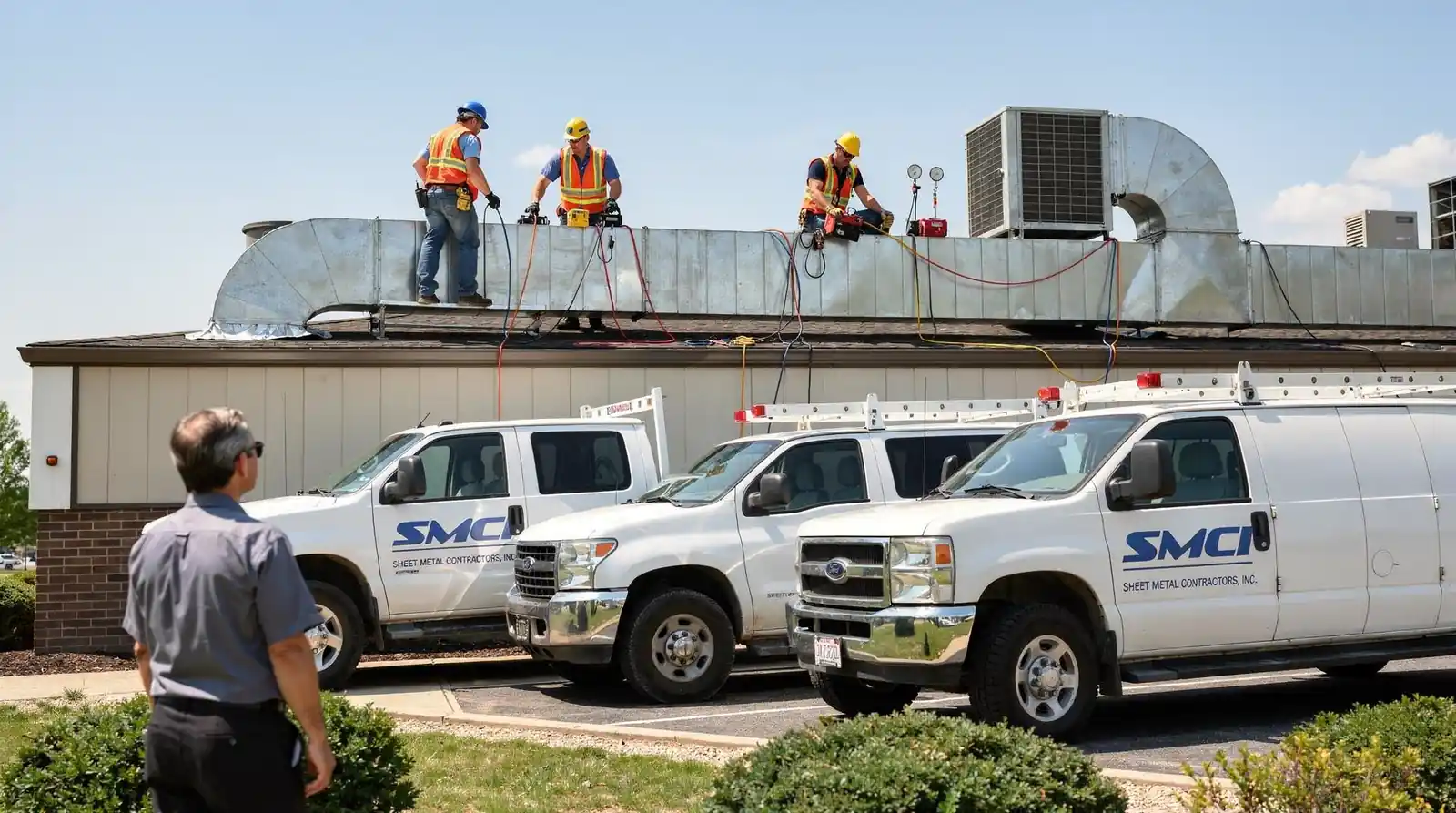
The August Dilemma: Dealing with Sudden Late-Summer AC Breakdowns
August in Missouri brings a specific kind of lingering heat, and deciding when a late-summer AC breakdown requires an overnight emergency call is a stress no homeowner wants to face. The timing is almost always inconvenient, frequently aligning with the busy back-to-school transition when your family desperately needs a full night of uninterrupted sleep. At SMCI, we've spent years helping local families navigate this exact scenario. You wake up at midnight, realize the vents are blowing warm air, and immediately have to make a choice: do you pick up the phone for immediate help, or can you safely shut the system down and wait until morning?
If you are facing a sudden failure right now and need guidance, our team provides trusted 24 hour emergency service and reliable AC repair in De Soto to restore your comfort safely and promptly.
Most homeowners default to panic when the cooling stops, assuming that any malfunction in the middle of the night requires an immediate emergency dispatch. However, in our extensive experience servicing De Soto and the surrounding areas, not every late-night failure is a true crisis. This guide provides a clear, symptom-based triage framework to help you evaluate your equipment's behavior. By understanding the mechanical signs your system is giving you, you can make an informed choice that protects your property, ensures your family's safety, and potentially saves you from unnecessary midnight panic.
Behind the Scenes: What Our Dispatch Logs Reveal About August AC Failures
When reviewing our 24/7 local dispatch logs for De Soto and Oakville, a distinct operational pattern emerges regarding late-summer cooling failures. We do not use a distant, third-party answering service; our SMCI team monitors real local requests, which gives us firsthand insight into exactly how and why systems fail during the hottest weeks of the year. A pattern we see often is that the vast majority of these August breakdowns are not random flukes—they are the direct result of cumulative heat stress.
By the time late summer arrives, your air conditioner has likely been running non-stop for months. Components like capacitors, contactors, and fan motors have endured thousands of starting cycles while baking in the intense outdoor heat. This prolonged electrical and thermal load pushes aging parts to their absolute limits. When we look at the data for 24 hour ac repair oakville and surrounding areas, we see a massive spike in sudden component failures precisely because the equipment has had zero recovery time since May.
Understanding this cumulative wear and tear is crucial for triage. When a part finally gives out after months of heavy lifting, it often creates very specific, identifiable symptoms. Reviewing these local dispatch patterns helps us identify exactly which of these symptoms require an immediate, overnight intervention to prevent safety hazards, and which symptoms simply mean an overworked part has safely failed and can be addressed during standard business hours.
When Is It Safe to Wait? Signs You Can Shut Off the AC Until Morning
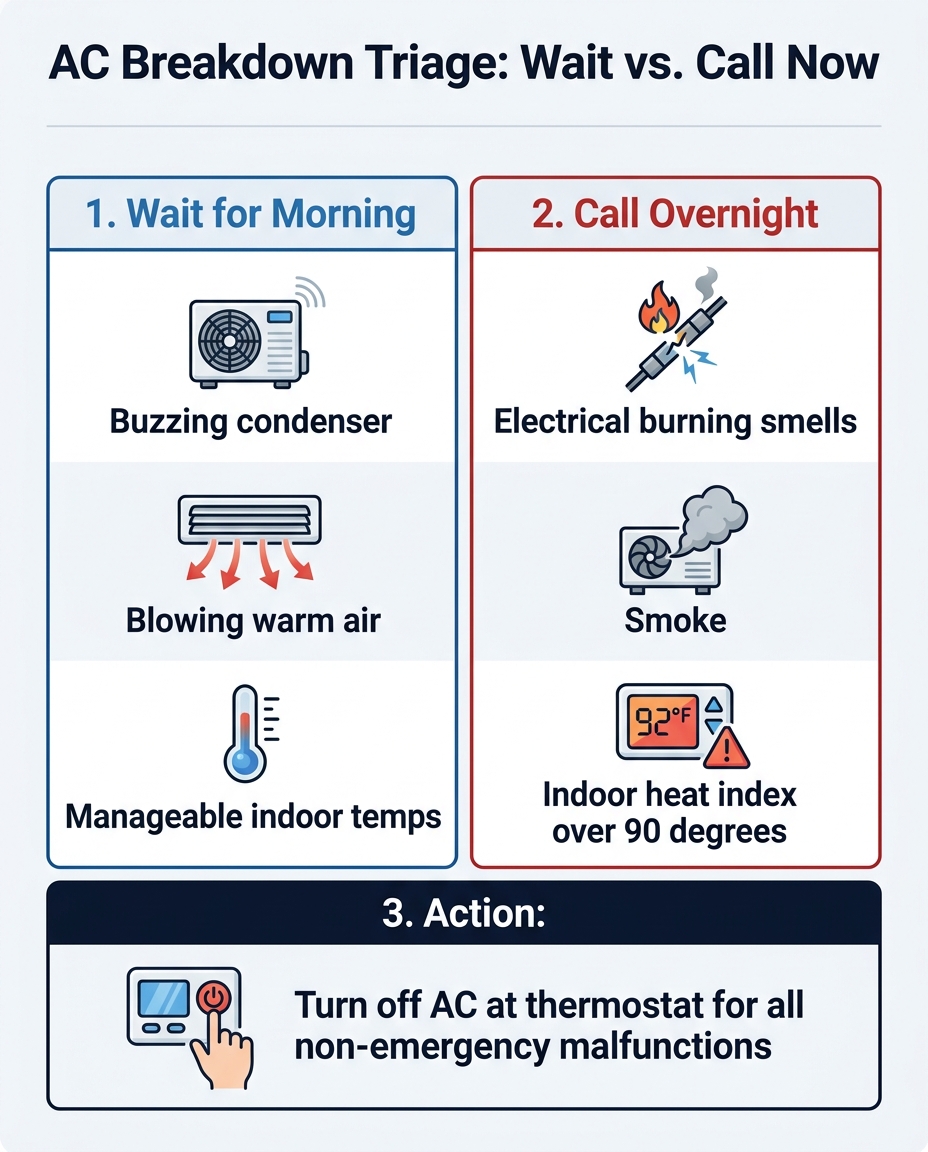
The most important rule of late-night HVAC triage that our technicians emphasize is that turning off a malfunctioning air conditioner is almost always the safest immediate action. Shutting down the equipment at the thermostat prevents further electrical strain and protects the compressor from catastrophic damage while you wait for morning service. If your home is relatively comfortable and you notice the following symptoms, you have permission to safely turn the system off and go back to sleep.
The Buzzing Condenser Unit (Blown Capacitor)
One of the most frequent calls our SMCI crew receives involves a buzzing condenser unit sitting outside in the dark. You might hear a distinct, electrical humming or buzzing noise coming from the outdoor cabinet, but notice that the large fan blade at the top is not spinning. This is the classic signature of a blown run capacitor—a common cumulative heat failure we replace constantly in late August.
What you should do: While the noise sounds alarming, it is not an immediate fire hazard as long as you take action. You must turn the air conditioner off at the indoor thermostat immediately. If you leave the system calling for cooling, the compressor will continue trying to start without the necessary electrical boost from the capacitor. This will cause the compressor to overheat, trip its internal overload protector, and potentially suffer permanent damage. Once the system is off, the buzzing will stop, and you can safely wait for a morning repair.
Blowing Warm Air Without Burning Smells
If you wake up sweating and realize the vents are steadily blowing room-temperature or warm air, your system has lost its ability to remove heat. This could be due to a frozen evaporator coil, a refrigerant leak, or a tripped breaker on the outdoor unit. As long as this warm airflow is not accompanied by any foul, acrid, or electrical burning smells, the system is not in immediate danger of catching fire.
What you should do: Turn the thermostat setting from "Cool" to "Off." If you leave a system running while it is blowing warm air, you risk severely freezing the indoor coil or burning out the compressor motor. Shutting it down stops the damage. You can leave the thermostat fan setting to "On" to keep air circulating through the house, but the cooling cycle must be stopped. Once safely powered down, you can call at dawn to schedule an inspection.
• Buzzing condenser unit, fan not spinning — Immediate Action Required: Turn AC off at thermostat — Overnight Risk Level: Low (if turned off)
• Vents blowing warm air, no unusual smells — Immediate Action Required: Turn AC off at thermostat — Overnight Risk Level: Low (if turned off)
• System completely unresponsive, no power — Immediate Action Required: Check breaker, leave off if tripped — Overnight Risk Level: Low
• Water dripping slowly near indoor unit — Immediate Action Required: Turn AC off, place a bucket — Overnight Risk Level: Moderate (property damage risk)
Handling these non-hazardous issues promptly the next day is much easier when the equipment hasn't been destroying itself all night. Staying on top of preventative AC maintenance earlier in the spring is the best way to catch these weak components before they turn into late-summer headaches.

True Emergencies: When to Request Immediate Overnight Dispatch
While many late-night breakdowns can safely wait, there are distinct situations where waiting is not an option. True emergencies are defined by immediate risks to personal safety, health, or significant property damage. When you encounter these critical signs, especially during the stressful August back-to-school transition when routines are tight, you need professional intervention right away.
Electrical Burning Smells and Safety Hazards
Your HVAC system uses a significant amount of high-voltage electricity. If you smell a strong, acrid odor resembling burning plastic, melting wire insulation, or a "fishy" electrical scent coming from your vents or the equipment itself, you are dealing with a severe electrical failure. This is a pattern we see often when dealing with a failing blower motor, a melted contactor, or damaged wiring.
• Shut off the power: Do not just turn off the thermostat. Go to your electrical panel and flip the breaker for the air conditioner to the "Off" position.
• Do not investigate: Never open the service panels to look for the source of the smoke or smell.
• Call immediately: This is a definitive trigger to utilize emergency HVAC repair services. An active electrical short is a severe fire hazard that requires an immediate overnight response.
High Indoor Temperatures and Vulnerable Family Members
An air conditioner failure becomes a health emergency when the indoor environment crosses the threshold of safety. The EPA and health organizations note that excessive indoor heat becomes hazardous when the indoor heat index exceeds 90 degrees Fahrenheit. Our team at SMCI stresses that this is especially critical if your household includes infants, elderly family members, individuals with respiratory conditions, or people taking medications that affect temperature regulation.
If the house is rapidly heating up and you cannot keep the indoor temperature at a safe level using open windows or portable fans, you should not force your family to endure the night. When health is on the line, reaching out for 24 hour air conditioning service de soto is the responsible and necessary choice to protect your loved ones from heat exhaustion.
The Hidden Danger: How Missouri's Humidity Impacts Indoor Safety
When deciding whether to wait for morning, many homeowners only look at the number on the thermometer. However, reviewing our dispatch logs in De Soto and Oakville highlights a hidden climate factor that dramatically changes how an indoor space feels: Missouri's oppressive late-summer humidity. Your air conditioner does two jobs simultaneously—it lowers the air temperature, and it extracts moisture from the indoor air.
When the AC breaks down in August, the home doesn't just get warmer; it rapidly becomes humid and stagnant. High indoor humidity prevents the human body's natural cooling mechanism—sweat evaporation—from working effectively. This means an indoor temperature of 82 degrees with 70% humidity will feel significantly hotter and more suffocating than the same temperature in a dry environment.
If you decide to shut the system off and wait for morning, you must manage this stagnant air. Turn on ceiling fans to create a wind-chill effect, and if the outdoor air is cooler and less humid than the indoor air, carefully open windows on opposite sides of the house to create cross-ventilation. However, if the lingering Missouri humidity makes the indoor air feel heavy, breathless, and unsafe, you must factor that heat index into your decision matrix. We always advise our customers that if the environment feels hazardous despite your best efforts to circulate air, it is time to escalate the situation to an emergency call.
Frequently Asked Questions About Late-Night AC Failures
What is considered an AC emergency?
In our experience, an AC emergency is any situation that poses an immediate risk to health or property. This includes electrical burning smells, visible smoke, sparking near the equipment, severe water leaks that threaten your ceilings or floors, or indoor temperatures rising to dangerous levels for vulnerable family members. If you are dealing with a simple mechanical failure that just causes discomfort, it is generally safe to turn the unit off and schedule standard service.
Can I sleep with a broken AC?
Yes, you can safely sleep with a broken AC as long as the indoor temperature remains manageable and there are no electrical hazards present. The most important step is to ensure the air conditioner is turned completely off at the thermostat so the equipment does not damage itself overnight. Use box fans, ceiling fans, and open windows if the outside weather permits to keep the air circulating in your bedroom.
Is a buzzing AC condenser dangerous?
A buzzing AC condenser is not inherently dangerous to your home, but it is highly damaging to your cooling system if left running. The buzzing sound usually indicates a failed run capacitor, meaning the compressor is trying to pull locked-rotor amps to start but cannot turn over. If you turn the thermostat off immediately, the danger to the equipment stops, and you can safely wait for a technician to replace the part in the morning.
Should I turn off my AC if it's blowing warm air late at night?
Yes, you should immediately turn off your AC at the thermostat if it starts blowing warm air. Leaving it running will not magically fix the cooling cycle, but it will force the system to waste electricity and potentially cause a minor issue to escalate. For example, if the system is low on refrigerant, leaving it running can cause the indoor evaporator coil to turn into a solid block of ice, complicating the eventual repair.
What happens if I ignore a broken capacitor and leave the AC on?
If you ignore a broken capacitor and leave the AC running, the compressor will overwork itself trying to start without the necessary electrical assistance. It will repeatedly overheat, trip its internal thermal overload switch, cool down, and try again. This brutal cycle "short-cycles" the motor and, as our technicians frequently see, will eventually burn out the compressor entirely, turning a straightforward component swap into a massive, system-wide replacement.
Rest Easy Knowing When to Call for Expert Help
Navigating an unexpected cooling failure during the chaotic August back-to-school transition does not have to be a source of panic. You now have a clear, symptom-based framework to guide your decision. If you hear a buzzing condenser unit or feel warm air coming from the vents, you have the knowledge and permission to safely shut the system down, protect your equipment from further damage, and rest easy until morning.
However, if you smell burning electrical components, see smoke, or realize the rising indoor heat index is putting your family's health at risk, do not hesitate to act. Trust your instincts and reach out for immediate overnight support. Whether you need an emergency dispatch right now or want to schedule a thorough diagnostic check for tomorrow morning, our local team at SMCI is ready to restore your home's comfort and give you back your peace of mind.