The Frustration of Small Metal Projects in a High-Volume Industry
Sourcing Custom Sheet Metal for Small Residential Projects When Commercial Shops Say No can feel incredibly frustrating when your home improvement project is stalled and you just need one specific piece to move forward. You have a clear vision for your home upgrade, but you quickly discover that standard, off-the-shelf parts from big-box hardware stores simply do not fit your unique space. Whether you are working on a historic property with non-standard dimensions or upgrading a complex HVAC system, generic components often fall short of providing the airtight, watertight seal your home requires.
For more comprehensive information on our capabilities, learn more about our sheet metal services.
A typical pattern we see for homeowners in De Soto and the greater St. Louis area involves spending hours calling multiple large fabricators, only to be rejected because the job is deemed "too small." These large facilities often require massive minimum orders, leaving residential property owners stranded. You are left at a critical decision point: where do you find a reliable local source for one-off custom bends without needing a commercial account?
Common residential projects that face commercial rejection include:
• Unique architectural flashing: Custom-angled pieces for bay windows, gazebos, or historic rooflines.
• Specialized chimney caps: Non-standard dimensions that require precise weatherproofing.
• Custom duct transitions: Adapting new, high-efficiency equipment to older, existing ductwork.
• Custom drip edges: Tailored lengths and angles to protect specific siding profiles.
The solution lies in finding an accessible, local in-house fabrication shop. Instead of battling the red tape of industrial manufacturers, working with a local team means your single piece of metal is treated with the same precision and importance as a massive commercial run, allowing you to complete your project safely and correctly.
Why Large Commercial Fabricators Turn Away Residential Requests
When a large commercial sheet metal shop declines your small project, it is easy to feel dismissed. However, understanding the mechanics of the high-volume manufacturing industry helps clarify why these rejections happen. It is rarely a reflection of the validity or importance of your residential project; rather, it is a strict limitation of their business model.
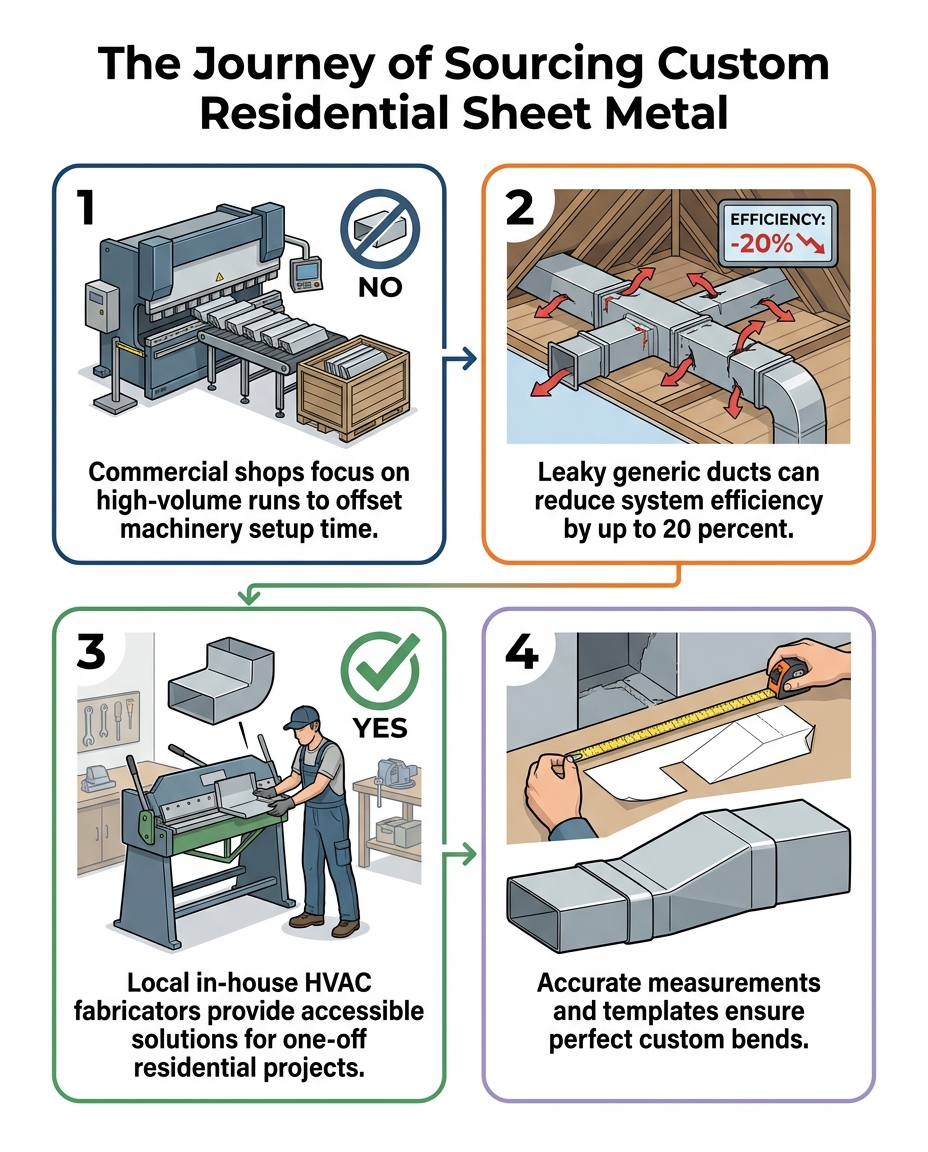
Commercial sheet metal fabrication relies heavily on economies of scale. These massive facilities are designed to produce hundreds or thousands of identical pieces in a single run. The machinery they use—such as heavy-duty CNC press brakes, automated plasma cutters, and massive coil lines—requires significant setup time. Calibrating the software, changing out the heavy tooling dies, and loading the specific gauge of metal can take an hour or more before a single cut or bend is even made.
The reality of commercial setup times:
If a commercial shop spends extensive time setting up a machine just to bend one piece of custom flashing for a homeowner in the greater St. Louis area, the labor and operational overhead far exceed what they can reasonably charge for that single item. Their high-volume production models simply do not allow for the agility required to pause a massive commercial run to accommodate a one-off residential job.
• Primary Focus — Commercial Mass-Production Shops: High-volume, identical production runs — Local In-House Fabricators: Custom, one-off, and specialized projects
• Setup Agility — Commercial Mass-Production Shops: Slow; requires extensive recalibration — Local In-House Fabricators: High; designed for quick tool changes
• Minimum Orders — Commercial Mass-Production Shops: Strict commercial account requirements — Local In-House Fabricators: No minimums; welcomes single pieces
• Customer Access — Commercial Mass-Production Shops: Corporate representatives and buyers — Local In-House Fabricators: Direct communication with the fabricator
By contrasting this rigid structure with the agility of smaller, dedicated local fabrication teams, it becomes clear why local shops are the better fit. A dedicated local fabricator maintains equipment and workflows specifically designed to pivot quickly between unique, custom jobs, ensuring your project gets the attention it deserves without the massive overhead requirements.

The Hidden Costs of Forcing Standard Parts to Fit Custom Spaces
When faced with rejection from commercial shops, the temptation to visit a local hardware store and force pre-fabricated, off-the-shelf parts into non-standard spaces is incredibly high. Homeowners often attempt to bend, crimp, or tape generic pieces to make them work. However, this "make-it-work" approach carries significant hidden costs that can compromise the integrity of your home and the efficiency of your mechanical systems.
Consider the impact on your heating and cooling system. According to statistics from EnergyStar.gov, leaky ducts can reduce heating and cooling system efficiency by as much as 20 percent. When you force a generic piece of metal to serve as a transition between your furnace and your main trunk line, you inevitably create microscopic gaps. These gaps allow conditioned air to escape into your basement or attic before it ever reaches your living spaces.
To ensure your system operates at peak efficiency, professional custom ductwork fabrication is the most reliable solution.
The cascading effects of imprecise metalwork:
• Severe Energy Loss: Your HVAC system is forced to run longer and work harder to maintain the temperature on your thermostat, accelerating wear and tear on the blower motor.
• Moisture Intrusion: On the exterior of your home, forcing generic flashing around a chimney or roofline creates pathways for water. Over time, this leads to rot, mold, and severe structural damage.
• Drafts and Air Quality Issues: Poorly sealed custom duct transitions can pull dust, insulation particles, and allergens from unconditioned spaces into your home's breathing air.
This is especially critical given Missouri's severe weather fluctuations. The intense heat of summer and the freezing temperatures of winter cause building materials to expand and contract constantly. This climate demands exact, custom-fitted exterior flashing and perfectly sealed duct transitions to prevent leaks and maintain indoor efficiency. Proper fabrication ensures longevity, safety, and peak system performance, protecting your home against the elements year-round.
Specialized Home Upgrades That Demand One-Off Metal Fabrication
Every home has unique architectural quirks and specific mechanical requirements that mass-produced materials simply cannot accommodate. When you are upgrading your property, certain specialized projects absolutely demand the precision of one-off custom sheet metal fabrication. Addressing these needs proactively ensures your home remains protected and efficient, regardless of the season.
Whether you are restoring a historic home with unique architectural designs or upgrading a modern property, custom metal bends provide tailored solutions that generic parts cannot match. These projects generally fall into two main categories: exterior protection and internal system optimization.
Exterior Flashing and Roofing Accents
Protecting unique outdoor structures with exact-fit metal is vital for the longevity of your property. Standard flashing is designed for standard roof pitches. If you have a custom gazebo, a unique bay window, or a non-standard chimney structure, generic flashing will leave gaps. Preventing water damage requires seamless custom bends that match the exact angle of your roofline.
For specialized exterior protection, explore the benefits of professional sheet metal roofing solutions.
Key exterior applications include:
• Custom gazebo roof flashing designed to handle heavy rain runoff.
• Bespoke chimney caps that prevent wildlife intrusion while allowing proper ventilation.
• Unique architectural accents that match the historical aesthetic of older homes while providing modern weatherproofing.
HVAC System Optimization
Internally, your HVAC system relies entirely on airtight airflow to function properly. When upgrading deteriorating ductwork connections, perfectly measured transitions are essential. Eliminating energy waste caused by generic, ill-fitting duct components is one of the most effective ways to improve your home's comfort.
This is particularly urgent during the September pre-heating season. Before the extreme winter weather hits, ensuring that your custom duct transitions are perfectly fabricated and sealed guarantees that your furnace will deliver maximum heat to your living spaces without losing valuable conditioned air to your basement or crawlspace.
Finding Accessible Fabrication Expertise Right in Your Backyard
You do not need to rely on massive commercial manufacturers to get high-quality, precise metalwork. Positioned right in your own community, local HVAC contractors with in-house fabrication capabilities serve as the ideal, accessible alternative. These local teams are uniquely equipped to handle the exact type of small, specialized projects that the big industrial shops turn away.
One of the primary advantages of working with a local shop is their specialized equipment. While they may not have the massive, automated coil lines of a commercial facility, in-house teams possess the specific, specialized tools needed for precise custom work. Hand brakes, power shears, slip rollers, and custom folding machines allow skilled fabricators to manipulate sheet metal into exact shapes, angles, and transitions required for residential applications.
To see how a local team can support your unique needs, review our custom residential services.
The local advantage for your custom projects:
• Regional Expertise: Local experts deeply understand regional building styles, historic home construction, and the specific weather challenges of the greater St. Louis area.
• Agility and Speed: A localized approach guarantees significantly faster turnaround times for critical home repairs, meaning your project won't be delayed for weeks waiting on a single part.
• Direct Communication: You can often speak directly to the fabricator who will be cutting and bending your metal, ensuring your exact specifications are understood.
At SMCI, our dedicated in-house custom sheet metal fabrication team in De Soto specifically welcomes small, unique residential projects. Rather than exclusively focusing on large commercial accounts, we take pride in providing the precision and care necessary to help local homeowners overcome their unique construction and HVAC challenges.
How to Prepare Your Project Specs for a Local Fabricator
When you find a local fabricator willing to take on your one-off project, arriving prepared is the best way to ensure your piece is made perfectly the first time. Custom fabrication relies entirely on the accuracy of the information provided. Taking the time to properly prepare your project specifications will save you time, eliminate frustration, and guarantee a seamless installation.
The most critical step is providing accurate measurements. If you are dealing with complex angles or unique custom duct transitions, simply writing down numbers on a notepad is often insufficient. Creating a physical cardboard template is highly recommended. A template allows the fabricator to see the exact angles and dimensions required, removing the guesswork from the bending process.
If you are exploring comprehensive home energy upgrades, you might also find value in reading about geothermal heating and cooling.
What to bring to your local fabrication shop:
• Precise Dimensions: Length, width, and exact degree of any necessary angles.
• Material Specifications: Know the desired metal gauge (thickness) and material type needed for the application (e.g., galvanized steel for ductwork, aluminum or copper for exterior architectural accents).
• Physical Templates: Stiff cardboard cutouts that replicate the exact space the metal needs to fit into.
• Clear Contextual Photographs: High-quality photos of the installation site help the fabricator understand how the piece will be used and how it needs to integrate with existing structures.
A crucial safety note: While sourcing custom fabrication for parts is something homeowners can manage, complex installations—especially those involving structural HVAC integration, gas flues, or intricate roofing tie-ins—should always be handled by a licensed professional. A perfectly fabricated piece of metal still requires expert installation to function safely and effectively.
Frequently Asked Questions About Small-Batch Sheet Metal Sourcing
Where can I get small custom sheet metal projects done?
The best place to get small custom projects done is a local HVAC contractor that maintains an in-house sheet metal fabrication shop. Unlike large industrial manufacturers that require massive minimum orders, these local shops are equipped with the hand brakes, shears, and rollers necessary to bend one-off pieces. Because they frequently fabricate custom ductwork for their own residential installations, they are highly capable of handling unique, small-scale requests for homeowners in the De Soto and greater St. Louis area.
Why do commercial sheet metal shops reject residential jobs?
Commercial shops reject residential jobs because their business model relies on high-volume economies of scale. The heavy machinery used in commercial facilities requires significant setup and calibration time, often taking an hour or more just to prepare for a specific bend or cut. Halting a massive production run to calibrate machinery for a single residential piece is simply not profitable or efficient for their operational workflow.
Who does custom sheet metal duct fabrication?
Custom sheet metal duct fabrication is typically performed by licensed HVAC contractors who have invested in their own in-house fabrication equipment. These professionals understand the precise airflow dynamics required for efficient heating and cooling systems. By fabricating the metal in-house, they can create exact transitions and plenums that perfectly match the specifications of the HVAC equipment, ensuring airtight seals and optimal system performance.
What information do I need to provide for a one-off metal bend?
To ensure a successful custom order, you need to provide precise measurements, the exact angles required, the preferred metal gauge (thickness), and the specific material type (such as galvanized steel, aluminum, or copper). For complex shapes or non-standard angles, providing a stiff cardboard template is highly recommended. Additionally, bringing clear photographs of the installation site helps the fabricator understand exactly how the custom piece needs to function.
How long does a small custom fabrication project typically take?
Turnaround times for small batches at a local in-house shop are generally much faster than commercial facilities, often ranging from a few days to a week, depending on the shop's current workload and material availability. Because local shops do not have to navigate corporate scheduling or massive production queues, they can often pivot quickly to accommodate urgent residential needs, especially during critical times like the pre-heating season.
Partner with a Local Team That Welcomes Your Custom Projects
Finding a reliable partner for small custom metalwork doesn't have to be a frustrating process of endless phone calls and rejections. When you step away from the rigid requirements of commercial mass-production facilities and look to your local community, you will find dedicated teams ready to help. Addressing these unique projects proactively—especially during the September pre-heating season—ensures your home is protected and your systems are running efficiently before extreme weather arrives.
We encourage you to gather your measurements, take clear photos of your project site, and create those helpful cardboard templates. By bringing these details to a dedicated local team, you can confidently secure the exact pieces you need. Reach out to our in-house fabrication experts today to discuss your specific project requirements and discover how simple sourcing custom sheet metal can actually be.